7 min read
Designing Better Cloud Systems with the AWS Well-Architected Framework
A plain-English walkthrough of the six Well-Architected pillars, the Well-Architected Tool, and how they connect to real design decisions.
Exam coverage — Domain 1: Cloud Concepts · Task Statement 1.2: Identify design principles of the AWS Cloud, including the pillars of the Well-Architected Framework and the differences between them.
Study path — Part 13 of 14 · Previous: Moving to AWS: Migration Strategies for Beginners · Next: AWS Cloud Economics
The problem this concept solves
Imagine you are handed a working app and told to keep it running. It technically works today, but you have no idea if it will survive a traffic spike, whether a hacker could get in through an overlooked setting, or whether you are quietly overpaying for resources nobody uses. "It works" and "it is well built" are not the same thing, and most beginners have no framework for telling the difference. That is the gap the AWS Well-Architected Framework is designed to close.
What it means in plain English
The AWS Well-Architected Framework is a set of questions and best practices, organized into six themes called pillars, that help you evaluate whether a cloud system is designed well. It is not a checklist you complete once and forget; it is closer to a home inspection checklist you can revisit as your "house" (your application) grows and changes. Each pillar focuses on a different concern, and a well-designed system balances all six rather than maximizing just one.
The six pillars
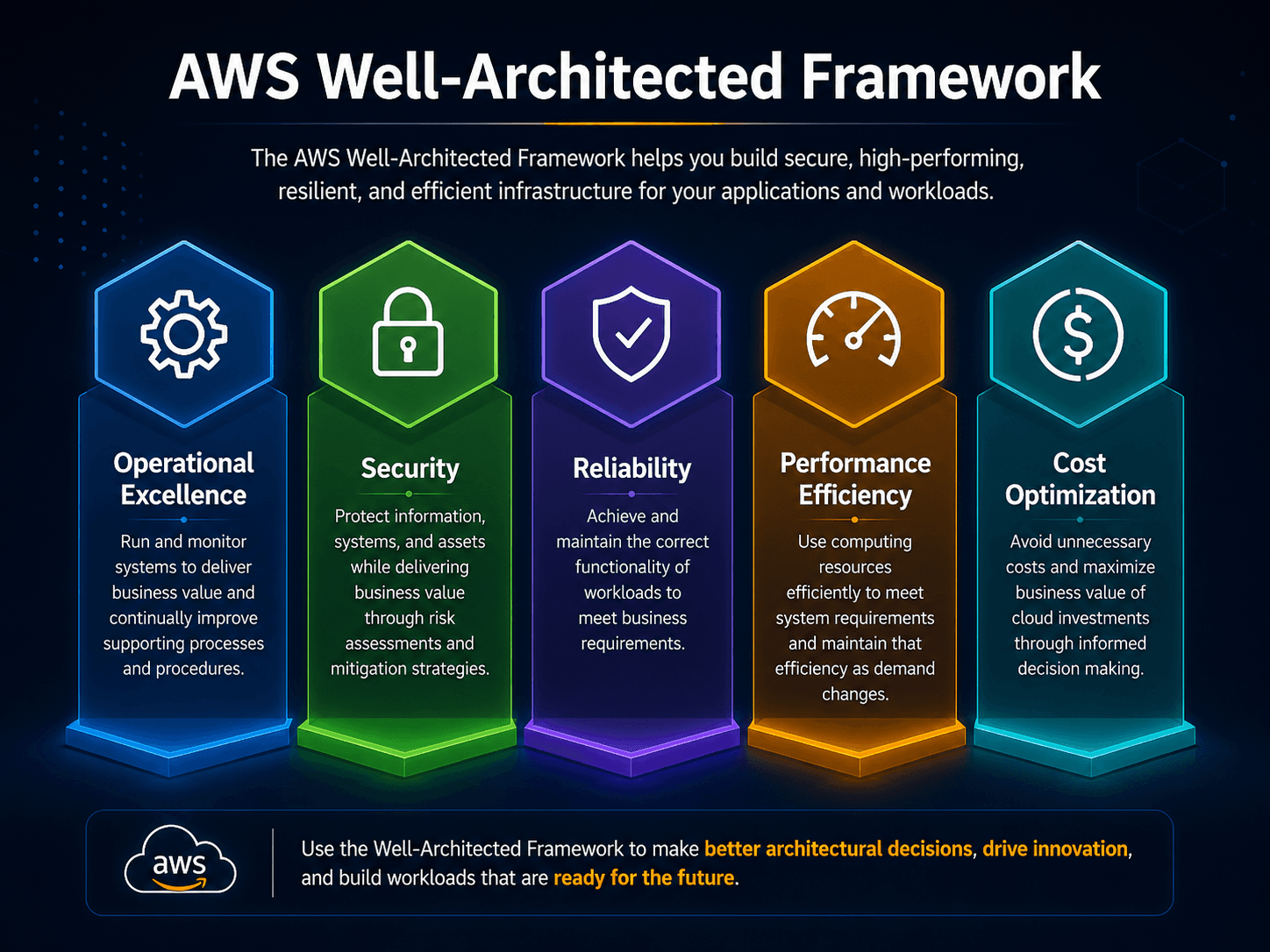
Operational Excellence is about how you run, monitor, and continuously improve a system, including how you deploy changes and respond when something goes wrong. A practical decision this pillar informs: automating deployments instead of making manual changes directly on a live system, which reduces human error.
Security is about protecting information, systems, and assets. A practical decision this pillar informs: applying least-privilege permissions, meaning people and systems get only the access they actually need, not broad access "just in case."
Reliability is about a system's ability to recover from failures and to meet changing demand without breaking. A practical decision this pillar informs: deploying an application across multiple Availability Zones (physically separate data centers within the same AWS Region) so that one data center's outage does not take the whole application down.
Performance Efficiency is about using computing resources efficiently as requirements change, including selecting the right type of resource for the job rather than the biggest one available. A practical decision this pillar informs: choosing a managed service that automatically handles scaling instead of manually guessing capacity ahead of time.
Cost Optimization is about avoiding unnecessary spending and getting the most value from what you do spend. A practical decision this pillar informs: right-sizing resources, meaning matching the size of a server or database to what the workload actually needs instead of over-provisioning "to be safe."
Sustainability is about reducing the environmental impact of running cloud workloads, such as energy and resource consumption. A practical decision this pillar informs: removing unused resources (like a test database nobody shut down), which reduces both waste and cost at the same time.
| Design choice | Well-Architected pillar |
|---|---|
| Deploying across multiple Availability Zones | Reliability |
| Using least-privilege permissions | Security |
| Automating deployments | Operational Excellence |
| Right-sizing resources | Cost Optimization |
| Choosing efficient managed services | Performance Efficiency |
| Removing unused resources | Sustainability |
The Well-Architected Tool
The AWS Well-Architected Tool is a free service available in the AWS Management Console that walks you through a structured set of questions based on the six pillars and compares your answers against best practices. You would use it after a workload exists (or is being planned in detail) to identify specific risks, such as a single point of failure or an overly permissive security setting, and get suggested next steps for addressing them. Think of it as a self-guided version of the same review a cloud architect might otherwise walk you through manually.
A practical example
Hypothetical scenario: A small startup runs its order-processing app on a single EC2 instance in one Availability Zone, with an administrator account shared among three engineers. Running the Well-Architected Tool surfaces two flags: the single Availability Zone is a Reliability risk, since one outage could take the whole app down, and the shared administrator account is a Security risk, since it violates least-privilege access. The team responds by adding a second Availability Zone and creating individual accounts with only the permissions each engineer needs, addressing both pillars without redesigning the entire application.
A brief look at specialized services
Beyond the six pillars, AWS also groups many services into specialized categories that a Well-Architected review might touch on depending on the workload. A few examples worth recognizing at a high level:
- Internet of Things (IoT): services like AWS IoT Core help connect and manage physical devices, such as sensors, that send data to the cloud.
- Analytics: services like Amazon Athena let you query data directly in storage without first loading it into a separate database.
- Media: AWS offers services for processing and delivering audio and video content at scale.
- Developer tools: services like AWS CodePipeline and AWS CodeBuild help teams automate building, testing, and deploying application changes, which connects directly back to the Operational Excellence pillar.
This article only introduces these categories by name. Each one is broad enough to deserve its own deeper study later.
Do not confuse these concepts
- Operational Excellence is about how you run and improve a system over time; Reliability is about whether the system keeps working when something fails. A system can be reliable in the moment but still poorly operated if nobody is monitoring or improving it.
- Performance Efficiency is about using resources well as needs change; Cost Optimization is about avoiding unnecessary spending. A system can be fast (performant) while still being wasteful (not cost-optimized), and the two require different fixes.
Cloud Practitioner exam connection
The exam expects you to match a described design decision to the correct pillar rather than memorize a long feature list. If a scenario mentions recovering from failure or handling unexpected demand, that points to Reliability. If it mentions permissions or encryption, that points to Security. If it mentions automation and deployment practices, that points to Operational Excellence. Be ready to distinguish Cost Optimization from Performance Efficiency, since both can sound similar but address different goals: one is about spending, the other is about efficient resource use.
Quick recall
| Pillar | The question it asks | Design choices that belong to it |
|---|---|---|
| Operational Excellence | "Can we run, monitor, and improve this?" | Automating deployments, infrastructure as code, runbooks |
| Security | "Is information and are systems protected?" | Least privilege, MFA, encryption, IAM roles |
| Reliability | "Can it recover and meet demand?" | Multi-AZ, backups, auto scaling, failure testing |
| Performance Efficiency | "Are we using resources efficiently as needs change?" | Right instance type, managed services, caching |
| Cost Optimization | "Are we avoiding unnecessary spend?" | Right-sizing, removing idle resources, Savings Plans |
| Sustainability | "Are we minimizing environmental impact?" | Higher utilization, efficient Regions, deleting unused data |
Common exam traps
- Reliability and Performance Efficiency get confused. Reliability is about surviving failure and meeting demand. Performance Efficiency is about using the right resources well. Multi-AZ is reliability; picking a better instance type is performance.
- Cost Optimization and Sustainability overlap but are not the same. Removing idle resources helps both, but the pillar is decided by why the scenario says to do it — saving money or reducing environmental impact.
- Six pillars, not five. Sustainability was added later and is frequently the missing option people forget.
- Automation belongs to Operational Excellence. Scenarios about CI/CD, repeatable deployments, and infrastructure as code land here.
- Well-Architected is not the Cloud Adoption Framework. Six pillars design a workload; CAF's six perspectives prepare an organization. See migration strategies.
- The Well-Architected Tool is free and self-service. It reviews workloads against the pillars; it does not automatically fix anything.
Key takeaways
- The Well-Architected Framework organizes cloud design guidance into six pillars: Operational Excellence, Security, Reliability, Performance Efficiency, Cost Optimization, and Sustainability.
- The AWS Well-Architected Tool applies these pillars to a specific workload and surfaces concrete risks and recommendations.
- A well-designed system balances all six pillars rather than optimizing only one at the expense of the others.
Check your understanding
- A company adds a second Availability Zone so its application can survive a data center outage. Which pillar does this address?
- What is the difference between the Cost Optimization pillar and the Performance Efficiency pillar?
- What does the AWS Well-Architected Tool actually do?
Suggested answers
- Reliability, because it is about the system's ability to recover from failures and keep running.
- Cost Optimization focuses on avoiding unnecessary spending and maximizing value, while Performance Efficiency focuses on using computing resources efficiently as requirements change; a system can be efficient but still expensive, or affordable but not efficient.
- It walks you through structured questions based on the six pillars, compares your workload against AWS best practices, and highlights specific risks along with suggested improvements.