6 min read
How AWS Delivers Applications Around the World
A beginner-friendly guide to AWS Regions, Availability Zones, and edge locations, and why they matter for reliability and speed.
Exam coverage — Domain 3: Cloud Technology and Services · Task Statement 3.2: Define the AWS global infrastructure, including Regions, Availability Zones, edge locations, and high availability.
Study path — Part 4 of 14 · Previous: Building Without Managing Servers · Next: Understanding AWS Networking Without Getting Lost
The problem this concept solves
Imagine your company runs an app from a single computer in a single building. If that building loses power, or the internet connection to it goes down, your app goes down with it. Even if the building stays up, a customer on the other side of the world might wait several seconds for each page to load, because their request has to travel a long physical distance to reach your one server and back.
How do you build something that keeps running even when one location fails, and that still feels fast no matter where your customers are?
What it means in plain English
AWS answers this with a layered physical network called the AWS global infrastructure. It is built from three main pieces: Regions, Availability Zones, and edge locations.
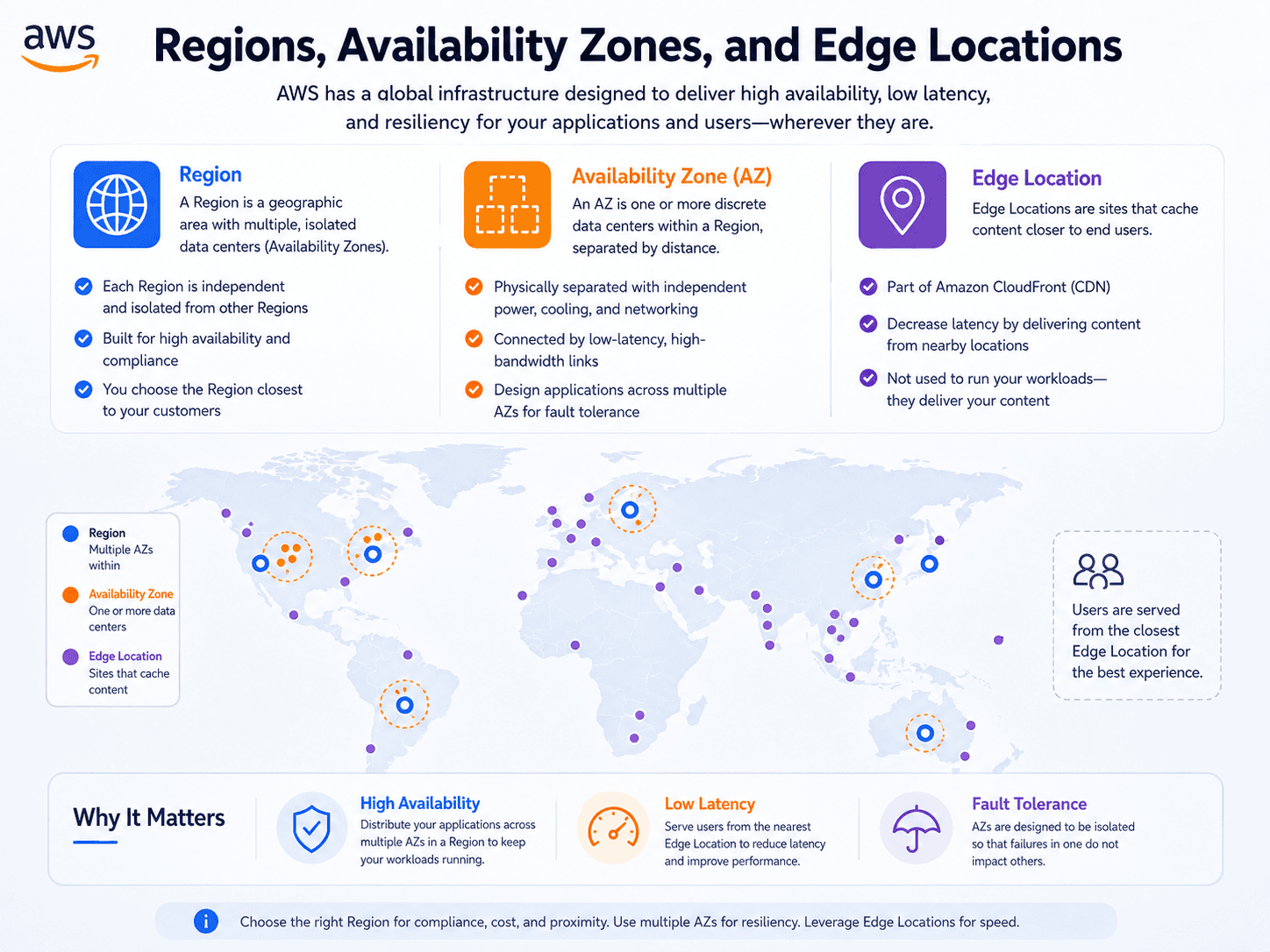
An AWS Region is a geographic area, such as a part of the United States or Europe, that contains a cluster of AWS data centers. Each Region operates independently, so choosing where to run your application affects things like the physical distance to your customers (which affects speed) and which local laws apply to your data (which affects compliance).
Within each Region are multiple Availability Zones (AZs), which are one or more discrete data centers with their own power, cooling, and networking. AZs within a Region are located far enough apart that they do not share a single point of failure, such as one power grid, but close enough together to communicate with very low delay.
Edge locations are smaller AWS sites, spread across many more cities than Regions, used to deliver content closer to end users. Think of a Region as a company's regional distribution warehouse, an Availability Zone as one of several separate buildings within that warehouse complex, and an edge location as a small local pickup counter positioned right in a customer's neighborhood.
Important AWS services and features
- Amazon CloudFront is AWS's content delivery network. It uses edge locations to cache and deliver static content, such as images or videos, from a location physically close to the requesting user, reducing the delay, or latency, the customer experiences.
- High availability describes designing a system so it keeps operating even if part of it fails, often by spreading resources across multiple Availability Zones so that the failure of one AZ does not take down the whole application.
- Fault tolerance is a related idea: a system that can absorb the failure of a component and keep working correctly, often with no noticeable interruption to the end user. High availability and fault tolerance are closely related, but fault tolerance implies an even higher bar of resilience, sometimes with no downtime at all.
A practical example
Hypothetical scenario: Northwind Outfitters, an online outdoor gear retailer, runs its application servers in two separate Availability Zones within the same AWS Region. If one AZ experiences a hardware failure, traffic automatically continues to be served from the second AZ, and customers do not notice an interruption. Because Northwind also sells to customers in Europe and Asia, it uses Amazon CloudFront to cache its product images at edge locations around the world, so a shopper in another country still sees pages load quickly, even though the main application servers stay in one Region.
Do not confuse these concepts
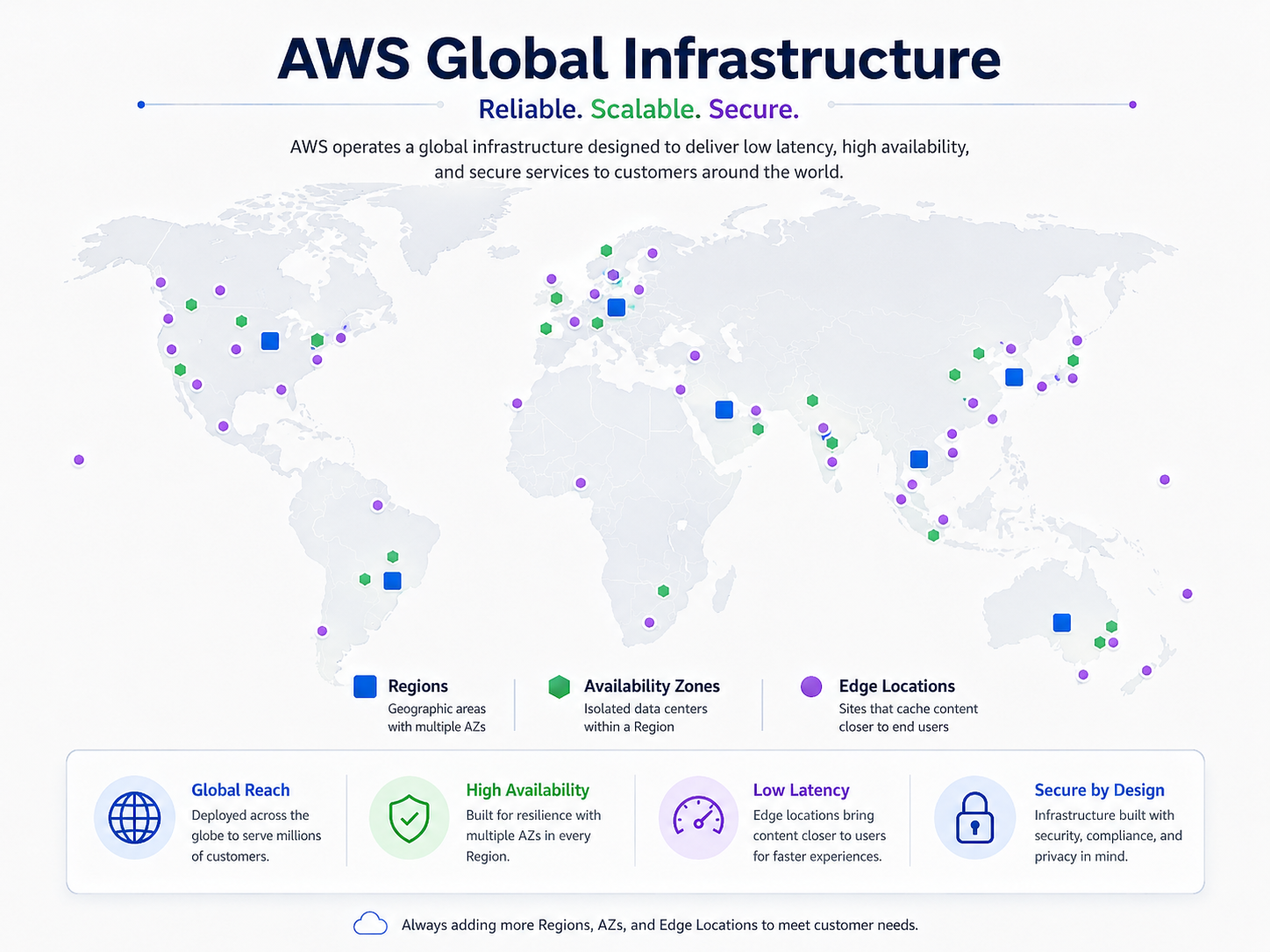
- Region: A geographic area containing multiple, independent Availability Zones.
- Availability Zone: One or more isolated data centers within a Region, used to protect against a single point of failure.
- Edge location: A smaller site, more numerous than Regions or AZs, used to cache and deliver content closer to end users through services like Amazon CloudFront.
Cloud Practitioner exam connection
The exam expects you to describe the relationship among Regions, Availability Zones, and edge locations, and to explain how spreading resources across multiple AZs supports high availability. You should also recognize general reasons a company might choose a specific Region, such as reducing latency for local customers, meeting data residency or regulatory requirements, or accessing a service only offered in that Region. Not every AWS service is available in every Region, so this is worth double-checking for a real project rather than assuming availability.
Quick recall
| Building block | What it is | Main reason it exists |
|---|---|---|
| Region | A geographic area containing multiple Availability Zones | Choose for latency, cost, compliance, and service availability |
| Availability Zone | One or more isolated data centers inside a Region | High availability — AZs do not share a single point of failure |
| Edge location | A small site in many more cities than Regions | Low latency content delivery via Amazon CloudFront |
| Local Zone | Compute placed close to a large population center | Single-digit-millisecond latency for specific metro areas |
| Wavelength Zone | Infrastructure inside a telecom provider's 5G network | Ultra-low latency for mobile and edge devices |
| Reason to use multiple Regions | Reason to use multiple AZs |
|---|---|
| Disaster recovery and business continuity | Surviving a single data center failure |
| Data sovereignty — data must stay in a country | Standard high-availability design |
| Serving users on another continent with low latency | Load balancing across a Region |
Common exam traps
- Multi-AZ and multi-Region answer different questions. Multi-AZ is the default answer for high availability inside one Region. Multi-Region shows up for disaster recovery, data sovereignty, or global users. Picking multi-Region for a plain availability question is the classic overcorrection.
- Edge locations do not run your application. They cache and deliver content. If a scenario describes running compute or a database closer to users, that is a Region or a Local Zone, not an edge location.
- Not every service exists in every Region. "The service is available everywhere" is almost always a wrong answer.
- AZs are not single buildings. An Availability Zone is one or more discrete data centers. The exam wording matters.
- High availability versus fault tolerance. High availability means minimal downtime and quick recovery. Fault tolerance is the stricter bar: the system keeps working through a failure with no interruption at all.
- CloudFront versus Global Accelerator. CloudFront caches content at the edge. Global Accelerator improves the network path to your application using the AWS backbone. Questions about caching images and video point to CloudFront.
Key takeaways
- AWS Regions contain multiple Availability Zones, and Availability Zones do not share a single point of failure with one another.
- Running an application across multiple Availability Zones helps achieve high availability.
- Edge locations, used by services like Amazon CloudFront, bring content physically closer to end users to reduce latency.
Check your understanding
- What is the difference between an AWS Region and an Availability Zone?
- Why might a company choose to deploy its application across two Availability Zones instead of one?
- What problem do edge locations and Amazon CloudFront solve for a global audience?
Suggested answers
- A Region is a geographic area containing multiple independent Availability Zones. An Availability Zone is one or more isolated data centers within that Region.
- Using two Availability Zones means that if one AZ experiences a failure, the application can keep running from the other, supporting high availability.
- Edge locations let AWS cache and deliver content from a location physically closer to the end user, which reduces the delay, or latency, that user experiences.