6 min read
Why Companies Use AWS: The Cloud Explained Simply
A plain-English look at what cloud computing actually means, and why businesses choose AWS over running their own servers.
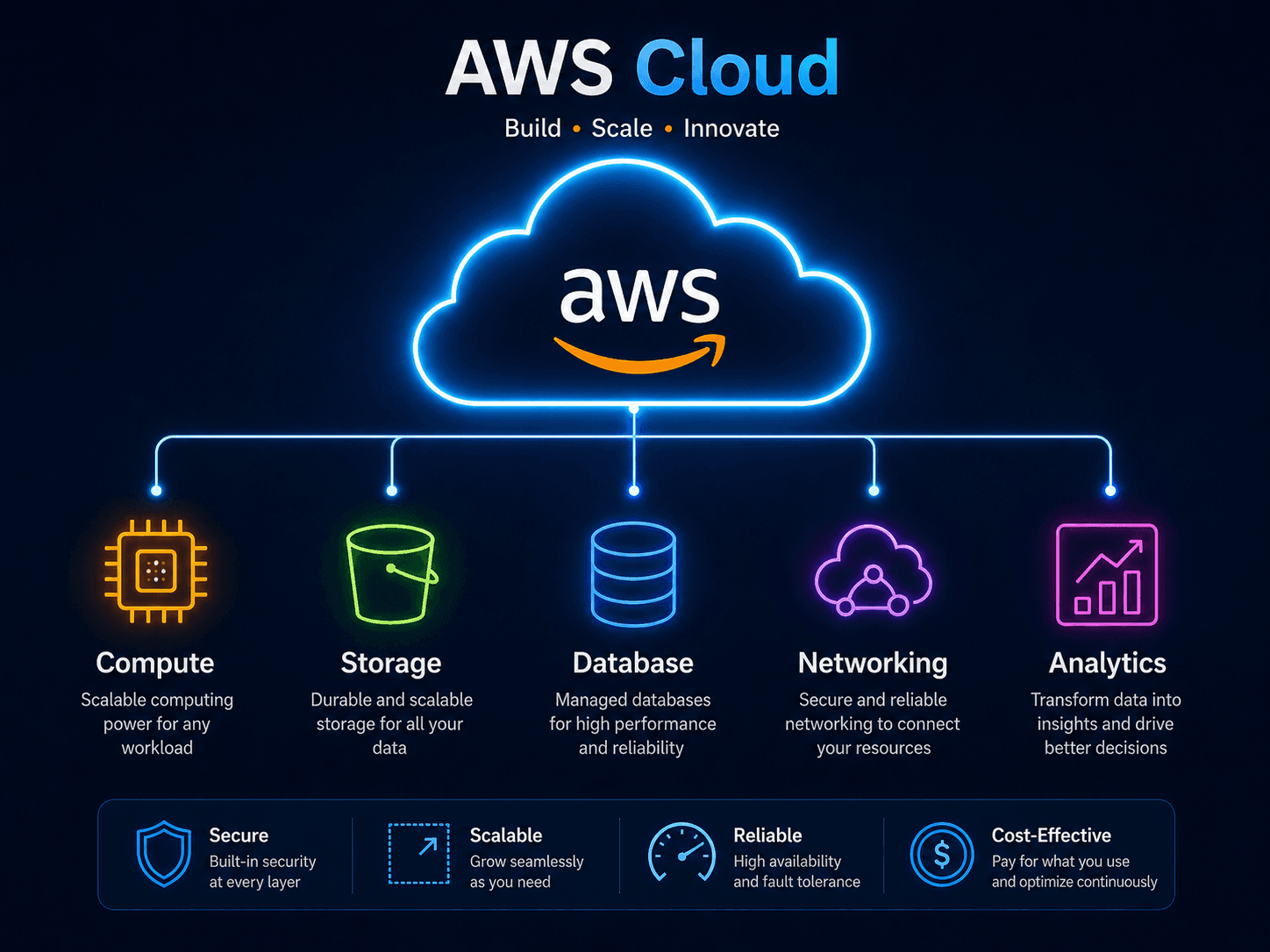
Exam coverage — Domain 1: Cloud Concepts · Task Statement 1.1: Define the benefits of the AWS Cloud. Domain 1 is 24% of your scored exam.
Study path — Part 1 of 14 · Next: Amazon EC2: Renting a Computer in the AWS Cloud
The problem this concept solves
Imagine you run a small online store. Every November, holiday shoppers flood your website. Every February, traffic drops back to normal. If you owned your own computers to run that website, you would have two bad choices: buy enough computers to survive your busiest day of the year (and let most of them sit idle the other eleven months), or buy just enough for a normal day (and watch your site crash during the holiday rush).
This is the exact problem cloud computing was built to solve.
What it means in plain English
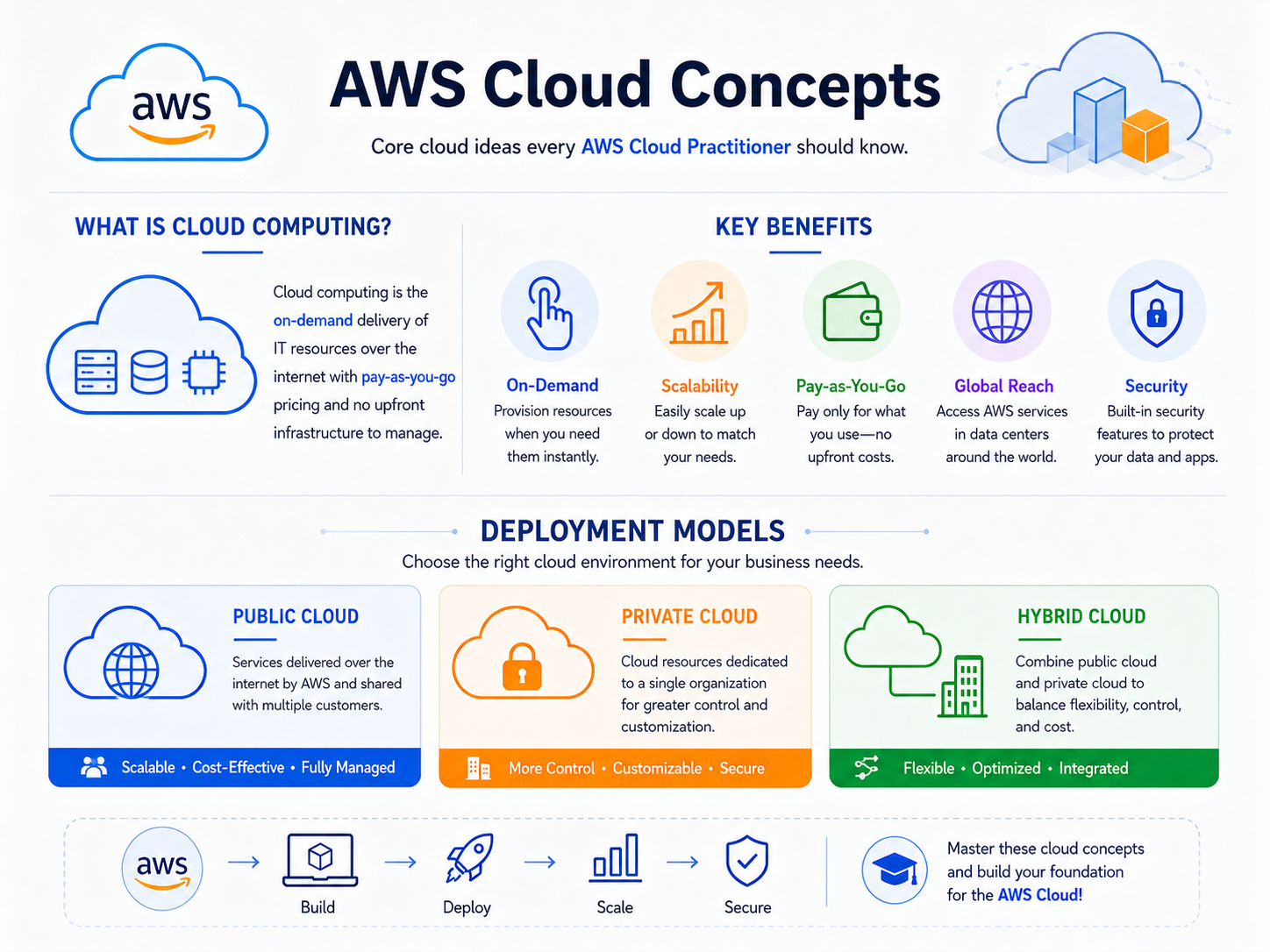
Cloud computing means renting computing power, storage, and other information technology (IT) resources from a provider over the internet, instead of buying and running your own physical machines. Amazon Web Services (AWS) is one such provider. Instead of owning a warehouse full of servers, you use AWS's servers and pay only for what you use, when you use it.
Two ideas sit at the center of this: scalability and elasticity. Scalability is the ability to increase or decrease your computing capacity as needed. Elasticity is a related but different idea: it means your resources automatically adjust to match demand in real time, without you manually stepping in each time. Think of scalability as your ability to add more checkout lanes at a grocery store, and elasticity as lanes that open and close by themselves as the line gets longer or shorter.
AWS also emphasizes agility, the ability to try new ideas quickly because you are not stuck waiting weeks for new hardware to arrive, and high availability, which means designing systems so they keep running even if part of the infrastructure fails.
Important AWS services and features
AWS itself is not a single service but a platform of many services. A few core ideas matter most for understanding its benefits:
- AWS global infrastructure is the physical network of data centers AWS operates worldwide. It lets a company deploy an application close to its customers, reducing delay and improving speed, without building a single data center itself.
- Pay-as-you-go pricing means you are billed for the compute time, storage space, or data transfer you actually consume, similar to a utility bill for electricity. There is no large upfront purchase required to get started.
- The AWS Shared Responsibility Model describes how security duties are divided. AWS is responsible for the security of the cloud, meaning the physical data centers, hardware, and core infrastructure. The customer is responsible for security in the cloud, meaning how they configure their accounts, data, and access permissions. This is only an introduction to the topic; How AWS Helps Protect Networks, Data, and Accounts covers it in more depth.
A practical example
Hypothetical scenario: Riverside Books is a small online bookstore. During most of the year, its website handles a steady trickle of orders. In the past, the owner bought physical servers sized for a "normal" day. Every Black Friday, the site slowed to a crawl and the company lost sales.
After moving to AWS, Riverside Books uses cloud resources that expand automatically as visitors arrive and shrink again once the sale ends. The company never buys extra hardware it will use for only one week a year. It pays more during the busy week and far less during quiet months, matching cost to actual demand.
Do not confuse these concepts
- Scalability is the capability to grow or shrink capacity, generally through a manual or planned change.
- Elasticity is the automatic, real-time adjustment of resources to match current demand, requiring no manual intervention once configured.
A system can be scalable without being elastic. A system that is elastic is, by definition, also scalable.
Cloud Practitioner exam connection
The AWS Certified Cloud Practitioner exam asks you to recognize the general benefits of the AWS Cloud, including elasticity, agility, high availability, and global reach. You should be able to distinguish scalability from elasticity, and understand at a conceptual level why pay-as-you-go pricing can reduce upfront cost. You do not need to calculate exact prices or memorize specific dollar figures.
Quick recall
| Term | What it means | Words that signal it on the exam |
|---|---|---|
| Scalability | Capacity can be increased or decreased | "can be increased," "add capacity," a planned change |
| Elasticity | Capacity adjusts automatically to real-time demand | "automatically," "as demand changes," "without intervention" |
| Agility | You can experiment quickly because no hardware purchase is needed | "try new ideas fast," "reduce time to market" |
| High availability | The system keeps running when part of it fails | "minimize downtime," "multiple Availability Zones" |
| Economies of scale | AWS's huge purchasing volume lowers the price you pay | "lower prices as AWS grows," "shared among many customers" |
| CapEx → OpEx | Large upfront purchase becomes pay-per-use spending | "no upfront cost," "variable expense," "avoid buying servers" |
Common exam traps
- Scalability and elasticity get swapped constantly. If the question says the resources adjust automatically or in real time, the answer is elasticity. If it just says capacity can grow or shrink, scalability is the safer pick.
- Agility is not application speed. It describes how fast your team can build and experiment, not how fast your website loads. Latency questions are about global infrastructure instead.
- Economies of scale is about AWS's scale, not yours. It means AWS buys hardware in enormous volume and passes savings to customers. It does not mean your own app got bigger.
- Watch the "of" versus "in" wording. AWS secures the infrastructure of the cloud; you secure what you put in it. That single preposition decides many Domain 2 questions.
- "Pay-as-you-go" does not mean cheaper in every case. The exam rewards "pay only for what you use," not "always costs less."
Key takeaways
- Cloud computing lets you rent IT resources instead of buying and maintaining your own physical hardware.
- Elasticity means resources adjust automatically to demand, while scalability more broadly describes the ability to increase or decrease capacity.
- The Shared Responsibility Model divides security duties between AWS and the customer; this article only introduces the idea.
Check your understanding
- Why can moving to AWS reduce upfront infrastructure costs for a company?
- How does elasticity differ from scalability?
- Which cloud security responsibilities generally remain with the customer, rather than with AWS?
Suggested answers
- Instead of purchasing physical servers in advance, a company pays AWS for the resources it actually uses, avoiding large upfront capital purchases.
- Scalability is the general ability to increase or decrease capacity. Elasticity specifically means that capacity adjusts automatically in response to real-time demand.
- Customers are generally responsible for configuring their own resources securely, managing access permissions, and protecting the data they put in the cloud.