7 min read
A Beginner's Guide to AI and Data Services on AWS
A plain-English introduction to SageMaker, Bedrock, ready-made AI services, and ETL tools like Glue and Athena, for readers new to AI and data pipelines.
Exam coverage — Domain 3: Cloud Technology and Services · Task Statement 3.7: Identify AWS AI/ML services and analytics services.
Study path — Part 8 of 14 · Previous: AWS Databases: Picking the Right Tool for the Data · Next: How AWS Helps Protect Networks, Data, and Accounts
The problem this concept solves
Say a company has years of customer support emails piling up, and employees waste time digging through them to find how a past issue was resolved. Reading and organizing that much text by hand isn't realistic. This is the kind of problem artificial intelligence and data tools are built to help with — finding patterns, extracting information, and answering questions from large amounts of data automatically. This article introduces those tools at a high level, without assuming any prior AI background.
What it means in plain English
Artificial intelligence (AI) is a broad term for software that performs tasks which normally require human thinking, like recognizing an image or understanding text. Machine learning (ML) is a specific approach to AI, where a system learns patterns from examples of data instead of following rules a person wrote by hand — similar to learning to recognize spam emails by seeing many examples, rather than being handed a rulebook. Generative AI is a newer category of AI that creates new content, such as text, images, or answers to questions, based on patterns learned from large amounts of existing data. This article only introduces these ideas at a high level.
Important AWS services and features
Amazon SageMaker is AWS's platform for building, training, and managing machine learning models. It's suited to teams that want to create custom models trained on their own data, rather than using an off-the-shelf solution.
Amazon Bedrock provides managed access to foundation models — large, pre-trained AI models — from AWS and other providers, through a single service. Instead of building a model from scratch, a company can use Bedrock to add generative AI features, like a chatbot, to their own application.
Several AWS services offer ready-made AI capabilities for common tasks, so teams don't need machine learning expertise to use them. Amazon Rekognition analyzes images and video, for example to detect objects or faces. Amazon Textract extracts text and data from scanned documents, like pulling line items from a receipt. Amazon Transcribe converts speech to text, Amazon Translate translates text between languages, and Amazon Comprehend analyzes text for things like sentiment or key phrases. Each solves one specific, well-defined problem rather than being a general-purpose AI tool.
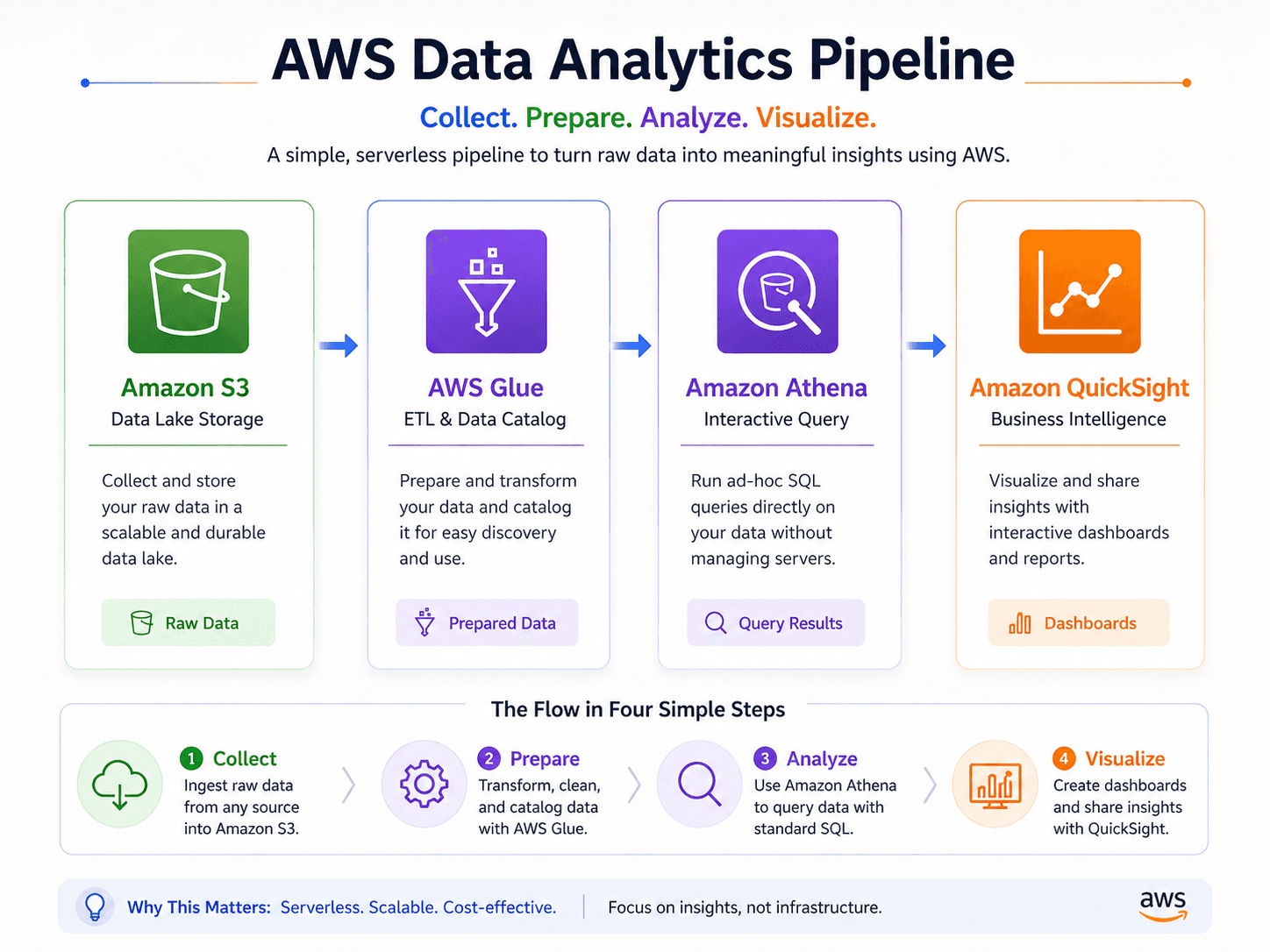
Beyond AI, many organizations need to move and prepare data before they can analyze it, a process known as extract, transform, load (ETL): pulling data out of its original source (extract), cleaning or reshaping it (transform), and loading it into a place suited for analysis (load). AWS Glue is a managed ETL service that can discover data, understand its structure, and transform it, without requiring you to manage the underlying servers.
Amazon S3 (Simple Storage Service, AWS's object storage service) commonly serves as a data lake — a central place to store large amounts of raw data in its original format before it's transformed or analyzed. Amazon Athena lets you run queries directly against data stored in S3, using standard SQL (structured query language), without first loading it into a separate database. Amazon Redshift, AWS's data warehouse service, supports deeper analytics on structured data, such as reports across years of historical records.
These tools handle real data, often including customer information. Responsible use means applying least-privilege permissions (giving each tool and user only the access it needs), understanding what data a model was trained on, and following applicable data privacy requirements.
A practical example
Consider a hypothetical company, Beacon Support Co. It stores years of customer support documents as raw files in an S3 data lake. AWS Glue crawls those files, identifies their structure, and prepares them for analysis. The support team then uses Amazon Athena to run quick queries against the data lake, like finding every document that mentions a specific product issue. Separately, the company uses Amazon Bedrock to build an internal assistant that employees can ask questions like "how did we resolve a shipping complaint last year?" — the assistant draws on the prepared documents to generate a helpful answer, with access permissions limited to employees who need it.
Do not confuse these concepts
- Amazon SageMaker helps teams build and manage custom machine-learning models from their own data.
- Amazon Bedrock provides managed access to pre-trained foundation models for generative AI, without building a model from scratch.
- AWS Glue helps discover, prepare, and transform data — it's an ETL tool, not an AI model service.
Cloud Practitioner exam connection
The exam expects you to recognize the purpose of a handful of AI and data services at a high level — for example, telling SageMaker (custom model building) apart from Bedrock (access to pre-trained foundation models), and recognizing Glue, Athena, and Redshift as tools that support preparing and analyzing data rather than performing AI tasks themselves. You are not expected to know how to build or train a model.
Quick recall
Most AI questions on this exam are really vocabulary matching. Learn the one-word job of each service.
| Service | Its one job |
|---|---|
| Amazon Rekognition | Images and video — "what is in this picture?" |
| Amazon Textract | Extracts text and data from scanned documents and forms |
| Amazon Transcribe | Speech → text |
| Amazon Polly | Text → speech |
| Amazon Translate | One language → another language |
| Amazon Comprehend | Meaning and sentiment inside text |
| Amazon Lex | Chatbots and voice assistants |
| Amazon Kendra | Intelligent search across company documents |
| Amazon SageMaker | Build, train, and deploy your own machine learning models |
| Amazon Bedrock | Managed access to foundation models for generative AI |
| Analytics service | Its one job |
|---|---|
| AWS Glue | Serverless ETL — discover, prepare, and transform data |
| Amazon Athena | Run SQL queries directly against data in S3 |
| Amazon Kinesis | Ingest and process streaming, real-time data |
| Amazon Redshift | Data warehouse for large-scale analytics |
| Amazon QuickSight | Dashboards and visualization |
| Amazon EMR | Big data frameworks such as Spark and Hadoop |
Common exam traps
- Transcribe and Translate sound alike and are not. Transcribe converts speech to text. Translate converts between languages. Polly is the reverse of Transcribe.
- Textract is not Rekognition. Textract reads documents. Rekognition analyzes images and video. A scanned invoice is Textract; a photo of a face is Rekognition.
- SageMaker versus Bedrock. SageMaker is for building and training your own models. Bedrock gives you access to existing foundation models for generative AI. "We want to use an existing large language model" means Bedrock.
- Athena queries S3 directly — no loading required. If a scenario emphasizes "without moving the data" or "query files in S3 with SQL," that is Athena, not Redshift.
- Glue is ETL, not storage or analysis. It prepares and transforms data so something else can use it.
- Kinesis means streaming. Keywords like "real time," "clickstream," or "continuously arriving" point here rather than to batch tools.
- Responsible AI is still your responsibility. AWS provides the service; you remain accountable for the data you feed it, who can access it, and how outputs are used.
Key takeaways
- AI, machine learning, and generative AI are related but distinct: ML is one approach to AI, and generative AI is a category of AI that creates new content.
- Ready-made services like Rekognition, Textract, Transcribe, Translate, and Comprehend each solve one specific task without requiring machine learning expertise.
- ETL tools like AWS Glue, combined with an S3 data lake and query tools like Athena, prepare data so it can be analyzed or used by AI services.
Check your understanding
- What is the difference between Amazon SageMaker and Amazon Bedrock?
- What does ETL stand for, and why does it matter before analyzing data?
- Which AWS service would help a company extract text from scanned paper documents?
Suggested answers
- SageMaker is a platform for building and training custom machine-learning models on your own data. Bedrock provides managed access to pre-trained foundation models, without needing to build a model yourself.
- ETL stands for extract, transform, load. Data usually needs to be pulled from its source, cleaned or reshaped, and loaded somewhere suited for analysis before it can be usefully queried or analyzed.
- Amazon Textract, which extracts text and data from scanned documents.
Continue learning
This blog series is an independent study resource and does not replace the official AWS exam guide or hands-on practice.